Marguerite Champeaux-Rousselot (2024-02-20)
Le papyrus Ipuwer : qui a écrit ce texte et quand ?
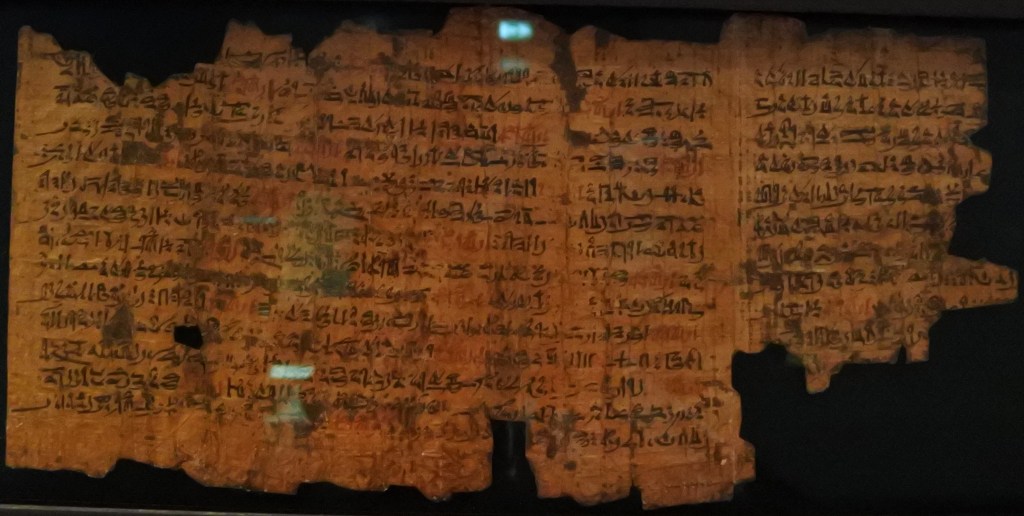
Ce document intitulé « papyrus Ipuwer » est actuellement conservé au Musée des antiquités de Leiden (Leyde) en Hollande sous la référence 344 (recto).
Découvert près de Memphis, en Egypte, au début du 19ème siècle, il a été traduit en 1909 par Sir Alan Henderson Gardiner, spécialiste de l’écriture hiératique égyptienne, une écriture cursive dérivée des hiéroglyphes sculptés dans les monuments de l’Egypte antique.
Le papyrus qui nous est parvenu (Papyrus Leiden 334) a été daté archéologiquement (matériau, encre, écriture etc.) de la XIXème dynastie (pendant le Nouvel Empire), vers 1650, mais il est en fait la copie soigneuse d’un document antérieur de plusieurs siècles. Le papyrus est malheureusement détérioré et comporte des lacunes, mais néanmoins le texte est long et assez lisible.
Le compositeur de ce texte est donc plus ancien. Il donne son propre nom : c’est le scribe Ipuwer ou Ipuver. Il est impossible de donner une date absolument sûre pour sa composition, mais l’étude de son écrit par la méthode historico-critique montre qu’il a vécu probablement durant le Moyen-Empire ou à la seconde période intermédiaire, au cours de la 12ème dynastie égyptienne. (1991 – 1786 av. J.C.).
Il énumère des cataclysmes où certains voient les plaies d’Egypte
L’auteur énumère une série impressionnante de cataclysmes et de catastrophes qui ont eu lieu.
Rien d’autre. Pas de commentaires ni de vraie narration.
Certains ont affirmé y trouver des ressemblances avec les dix plaies d’Egypte envoyées par Dieu sur le Pharaon qui lui résistait : Nil couleur de sang, famine, sécheresse, rébellion d’esclaves, fuite d’esclaves emportant les richesses des Egyptiens, et mort ravageant tout le pays…
Cette affirmation est-elle exacte ? Peut-être prouver l’historicité des plaies d’Egypte et de l’exode des Israélites raconté dans le livre de l’Exode ?
Vous trouverez ci-dessous
– d’abord le texte intégral de ce manuscrit (traduit en anglais)[1]
– et ensuite en deux colonnes en français les points relevés principaux que nous allons commenter dès maintenant.
La liste des calamités qui sont censées s’être passées couvre la plupart des cataclymes possibles habituels, plus quelques catastrophes exceptionnelles : maux grands et petits, privés et publics, naturels et humains !
Environ 150 malheurs sont cités. Cette énumération est précise et concrète. Ell est détaillée et longue. Pour en donner une idée, sa traduction en anglais remplit 8 ou 9 pages en format A4 caractères 12.
Il s’agit là peut-être d’un récit réaliste, mais les excès flagrants (l’Egypte semble y avoir survécu !) montreraient qu’il s’agit bien plutôt soit de catastrophes démesurément grossies dans une épopée par exemple ou un texte religieux, soit d’un récit de type catastrophiste.
Ces récits étaient destinés à faire peur (pour se rassembler par exemple autour d’un chef sécurisant) soit à rassurer, en montrant le contraste si, après cette lecture affligeante, on contemplait le pays avec soulagement en notant tout ce qui allait bien par contraste dans la réalité.
Le style épique des sagas, des gigantomachies, des luttes entre des principes manichéens conduisent à décrire des catastrophes. Si le but est de louer un chef, les catastrophes noircies le plus possible également feront d’autant mieux ressortir ses capacités et la reconnaissance qu’on doit avoir envers lui.
Premier problème : les datations des deux textes ne concordent pas
Or, si l’on se réfère à ce qui est relaté dans le livre biblique 1 Rois, à savoir que l’exode d’Égypte conduit par Moïse aurait eu lieu 480 ans avant que le roi Salomon ne construisît l’éventuel Temple à Jérusalem vers l’an 1000 ou 900 avant J.-C., l’exode aurait eu lieu vers l’an 1480.
C’est à dire que ce que raconte Ipuwer est antérieur de 500 ans environ par rapport à la datation avancée par le récit biblique pour l’exode des hébreux.
Deuxième problème : quelques allusions aux plaies dans 150 autres
Comparons en partant de l’énumération d’Ipuwer.
Il décrit des phénomènes qui frappent ceux qui connaissent la Bible : Nil de sang, famine, sécheresse, rébellion d’esclaves, fuite d’esclaves emportant les richesses des Egyptiens, et mort ravageant tout le pays.
Il est certes tentant de les y trouver là, dans ce manuscrit.
Mais ces points sont en fait, objectivement très limités : sur 150 points environ, il y a une dizaine de points plus ou moins communs.
Les points communs sont au nombre de 7 seulement :
1Le fleuve est de sang.
2 L’eau manque
3 Les incendies sévissent
4 Les moissons, le petit bétail, les poissons, la campagne, le lin, les troupeaux meurent.
5 La lumière manque.
6 Un feu s’élève dans le ciel et ses flammes se dirigent vers les ennemis.
7 Les esclaves femelles ont reçu des parures précieuses
Et 3 points sont partiellement communs :
8 La peste frappe les troupeaux égyptiens, mais dans l’Exode, elle frappe les Egyptiens
9 La mort frappe en Egypte les enfants des princes et le frère y enterre son frère, mais dans l’Exode, elle ne frappe que les premiers-nés (nouveau-nés semble-t-il)
10 Enfin, chez Ipuver, la prison est en ruine, mais dans l’Exode, elle n’est mentionnée que comme le lieu où meurent également les premiers-nés des captifs.
Cela représente 5% environ de points communs. (Cela recoupe d’ailleurs le fait que sur environ 4965 mots il n’y a qu’environ 270 mots (dont des articles etc.) qui permettent d’évoquer des choses similaires de part et d’autre soit même pas 5% de mots).
Il nous semble donc clair que les ressemblances sont en fait si limitées qu’elles ne sont pas démonstratives : vu la variété et l’exhaustivité de la description du scribe, les points communs peuvent être accidentels ou dus au hasard, mais, vu le sujet et le nombre de points dans le texte égyptien, il est surtout prévisible statistiquement, qu’il y en ait certains de communs..
Troisième problème : les dix plaies n’y sont pas toutes
Comparons en partant cette fois des dix plaies d’Egypte bibliques, on voit aussi plusieurs plaies ne sont pas du tout évoquées (grenouilles, sauterelles…)
Conclusion : une ressemblance pour qui veut se bercer d’illusion
1°)
A l’observer scientifiquement, le papyrus énumère des phénomènes qui sont certes frappants pour ceux qui connaissent les dix plaies d’Egypte racontées dans le livre de l’Exode : Nil de sang, famine, sécheresse, rébellion d’esclaves, fuite d’esclaves emportant les richesses des Egyptiens, et mort ravageant tout le pays…
Mais en réalité, scientifiquement, il n’est pas possible de dire que le texte égyptien ressemble beaucoup au texte hébreu.
2°)
De plus, il est difficilement soutenable que le texte composé par Ipuwer puisse y faire référence. En effet, les datations des textes sont inversées et il n’est guère vraisemblable que Ipuver annonce avec 500 ans d’avance l’exode vécu par Moïse.
Le papyrus d’ailleurs ne fournit aucune référence explicite au peuple d’Israël ni à Moïse.
Ainsi, la critique interne du texte démontre-t-elle qu’il ne peut servir, scientiquement, de « preuve».
3°)
D’ailleurs l’archéologie s’oppose à la réalité même de cet exode à la date évoquée par la Bible à savoir vers l’an mille.
Par contre les informations archéologiques et contextuelles se recoupent toutes, se complètent et font se dégager une hypothèse :
Comme l’Egypte a longtemps dominé le pays de Canaan ou la Philistie, ainsi que les populations de la région qui deviendront bien plus tard les « fils d’Israël », ce texte pouvait logiquement avoir été connu de leurs habitants.
Ensuite, lors de la déportation du Royaume du Nord par les Assyriens, (en 720) puis pendant la déportation du Royaume du Sud par les Babyloniens, (597-538), déportation pendant lesquels les habitants du royaume de Judah ont rêvé d’être libérés et ont tenté de se maintenir, il peut avoir suscité beaucoup d’intérêt !
Il peut même avoir suscité un intérêt redoublé au moment du miracle qui leur arriva 50 ans après, en 538 sous Cyrus roi de Perse ! Ils ont en effet quitté dans de bonnes conditions leur situation d’émigrés.
Enfin, pendant la période postexilique (après 538) lorsque le peuple se reconstruisait, ce texte a pu inspirer le récit (fictif) des dix plaies appliquées à l’Egypte par Dieu, Moïse servant d’intermédiaire, cette Egypte qui ne voulait pas les laisser partir pour retrouver leur liberté.
C’est ce processus qui est le plus vraisemblable.
Ce déroulement hypothétique s’appuie sur d’autres textes et il est renforcé par les nombreuses découvertes archéologiques récentes qui s’opposent à une lecture guidée par des préjugés et le désir de pouvoir considérer la Bible comme un livre totalement historique : l’Histoire comme discipline ne se fondait pas sur les mêmes critères que les nôtres, et la lire ainsi serait faire un anachronisme. Cela conduirait à un contresens sur sa réelle valeur et les motivations profondes de son écriture.
Marguerite Champeaux-Rousselot
2024-02-20
*************
Texte du papyrus (en anglais) et notes
Puis comparaison des points principaux
Lacunae in the papyrus text are marked by […].
I
[. .] The door [keepers] say: « Let us go and plunder. »
The confectioners [. . .].
The washerman refuses to carry his load [. . .]
The bird [catchers] have drawn up in line of battle [. . . the inhabitants] of the Delta carry shields.
The brewers [. . .] sad.
A man regards his son as his enemy. Confusion [. . .] another. Come and conquer; judge [. . .] what was ordained for you in the time of Horus, in the age [of the Ennead . . .]. The virtuous man goes in mourning because of what has happened in the land [. . .] goes [. . .] the tribes of the desert have become Egyptians everywhere.
Indeed, the face is pale; [. . .] what the ancestors foretold has arrived at [fruition . . .] the land is full of confederates, and a man goes to plough with his shield.
Indeed, the meek say: [« He who is . . . of] face is as a well-born man. »
Indeed, [the face] is pale; the bowman is ready, wrongdoing is everywhere, and there is no man of yesterday.
Indeed, the plunderer [. . .] everywhere, and the servant takes what he finds.
Indeed, the Nile overflows, yet none plough for it [I/1]. Everyone says: « We do not know what will happen throughout the land. »
Indeed, the women are barren and none conceive. Khnum fashions (men) no more because of the condition of the land.
II
Indeed, poor men have become owners of wealth, and he who could not make sandals for himself is now a possessor of riches.
Indeed, men’s slaves, their hearts are sad, and magistrates do not fraternize with their people when they shout.
Indeed, [hearts] are violent, pestilence is throughout the land, blood is everywhere, death is not lacking, and the mummy-cloth speaks even before one comes near it.
Indeed, many dead are buried in the river; the stream is a sepulcher and the place of embalmment has become a stream.
Indeed, noblemen are in distress, while the poor man is full of joy. Every town says: « Let us suppress the powerful among us. » [II/1]
Indeed, men are like ibises. Squalor is throughout the land, and there are none indeed whose clothes are white in these times.
Indeed, the land turns around as does a potter’s wheel; the robber is a possessor of riches and [the rich man is become] a plunderer.
Indeed, trusty servants are [. . .]; the poor man [complains]: « How terrible! What am I to do? »
Indeed, the river is blood, yet men drink of it. Men shrink from human beings and thirst after water. [II/2]
Indeed, gates, columns and walls are burnt up [II/3], while the hall of the palace stands firm and endures.
Indeed, the ship of [the southerners] has broken up; towns are destroyed and Upper Egypt has become an empty waste.
Indeed, crocodiles [are glutted] with the fish they have taken, for men go to them of their own accord [II/4]; it is the destruction of the land. Men say: « Do not walk here; behold, it is a net. » Behold, men tread [the water] like fishes, and the frightened man cannot distinguish it because of terror.
Indeed, men are few, and he who places his brother in the ground is everywhere. When the wise man speaks, [he flees without delay].
Indeed, the well-born man [. . .] through lack of recognition, and the child of his lady has become the son of his maidservant.
III
Indeed, the desert is throughout the land, the nomes are laid waste, and barbarians [III/1] from abroad have come to Egypt[III/2].
Indeed, men arrive [. . .] and indeed, there are no Egyptians [III/3] anywhere.
Indeed, gold and lapis lazuli, silver and turquoise, carnelian and amethyst, Ibhet-stone and [. . .] are strung on the necks of maidservants. Good things are throughout the land, (yet) housewives say: « Oh that we had something to eat! »
Indeed, [. . .] noblewomen. Their bodies are in sad plight by reason of their rags, and their hearts sink when greeting [one another]. Indeed, chests of ebony are broken up, and precious ssndm-wood is cleft asunder in beds [. . .].
Indeed, the builders [of pyramids have become] cultivators, and those who were in the sacred bark are now yoked [to it]. None shall indeed sail northward to Byblos today; what shall we do for cedar trees for our mummies, and with the produce of which priests are buried and with the oil of which [chiefs] are embalmed as far as Keftiu? They come no more; gold is lacking [. . .] and materials for every kind of craft have come to an end. The [. . .] of the palace is despoiled. How often do people of the oases come with their festival spices, mats, and skins, with fresh rdmt-plants, grease of birds . . . ?
Indeed, Elephantine and Thinis […] of Upper Egypt, (but) without paying taxes owing to civil strife. Lacking are grain, charcoal, irtyw-fruit, m’w-wood, nwt-wood, and brushwood. The work of craftsmen and [. . .] are the profit of the palace. To what purpose is a treasury without its revenues? Happy indeed is the heart of the king when truth comes to him! And every foreign land [comes]! That is our fate and that is our happiness! What can we do about it? All is ruin!
Indeed, laughter is perished and is [no longer] made; it is groaning that is throughout the land, mingled with complaints.
IV
Indeed, every dead person is as a well-born man. Those who were Egyptians [have become] foreigners and are thrust aside.
Indeed, hair [has fallen out] for everybody, and the man of rank can no longer be distinguished from him who is nobody.
Indeed, [. . .] because of noise; noise is not [. . .] in years of noise, and there is no end [of] noise.
Indeed, great and small [say]: « I wish I might die. » Little children say: « He should not have caused [me] to live. »
Indeed, the children of princes are dashed against walls, and the children of the neck [IV/1] are laid out on the high ground [IV/2].
Indeed, those who were in the place of embalmment are laid out on the high ground, and the secrets of the embalmers are thrown down because of it.
Indeed, that has perished which yesterday was seen, and the land is left over to its weakness like the cutting of flax.
Indeed, the Delta in its entirety will not be hidden, and Lower Egypt puts trust in trodden roads. What can one do? No [. . .] exist anywhere, and men say: « Perdition to the secret place! » Behold, it is in the hands of those who do not know it like those who know it. The desert dwellers are skilled in the crafts [IV/3] of the Delta.
Indeed, citizens are put to the corn-rubbers, and those who used to don fine linen are beaten with . . . Those who used never to see the day have gone out unhindered; those who were on their husbands’ beds, let them lie on rafts. I say: « It is too heavy for me, » concerning rafts bearing myrrh. Load them with vessels filled with [. . . Let] them know the palanquin. As for the butler, he is ruined. There are no remedies for it; noblewomen suffer like maidservants, minstrels are at the looms within the weaving-rooms, and what they sing to the Songstress-goddess is mourning. Talkers [. . .] corn-rubbers.
Indeed, all female slaves are free with their tongues, and when their mistress speaks, it is irksome to the maidservants.
Indeed, trees are felled and branches are stripped off [IV/4].
V
I have separated him and his household slaves, and men will say when they hear it: « Cakes are lacking for most children; there is no food [. . .]. What is the taste of it like today? »
Indeed, magnates are hungry and perishing, followers are followed [. . .] because of complaints.
Indeed, the hot-tempered man says: « If I knew where God is, then I would serve Him. »
Indeed, [Right] pervades the land in name, but what men do in trusting to it is Wrong.
Indeed, runners are fighting over the spoil [of ] the robber, and all his property is carried off.
Indeed, all animals, their hearts weep; cattle moan because of the state of the land.
Indeed, the children of princes are dashed against walls, and the children of the neck are laid out on the high ground. Khnum groans because of his weariness.
Indeed, terror kills; the frightened man opposes what is done against your enemies. Moreover, the few are pleased, while the rest are . . . Is it by following the crocodile and cleaving it asunder? Is it by slaying the lion roasted on the fire? [Is it] by sprinkling for Ptah and taking [. . .]? Why do you give to him? There is no reaching him. It is misery which you give to him.
Indeed, slaves . . . throughout the land, and the strong man sends to everyone; a man strikes his maternal brother. What is it that has been done? I speak to a ruined man.
Indeed, the ways are [. . .], the roads are watched [V/1]; men sit in the bushes until the benighted traveler comes in order to plunder his burden, and what is upon him is taken away. He is belabored with blows of a stick and murdered.
Indeed, that has perished which yesterday was seen, and the land is left over to its weakness like the cutting of flax, commoners coming and going in dissolution [. . .].
VI
Would that there were an end of men, without conception, without birth! Then would the land be quiet from noise and tumult be no more.
Indeed, [men eat] herbage and wash [it] down with water; neither fruit nor herbage can be found [for] the birds, and [. . .] is taken away from the mouth of the pig. No face is bright which you have [. . .] for me through hunger.
Indeed, everywhere barley has perished and men are stripped of clothes, spice, and oil; everyone says: « There is none. » The storehouse is empty and its keeper is stretched on the ground; a happy state of affairs! . . .
Would that I had raised my voice at that moment, that it might have saved me from the pain in which I am.
Indeed, the private council-chamber, its writings are taken away and the mysteries which were [in it] are laid bare [VI/1].
Indeed, magic spells are divulged [VI/2]; smw– and shnw-spells [VI/3] are frustrated because they are remembered by men.
Indeed, public offices are opened and their inventories are taken away; the serf has become an owner of serfs.
Indeed, [scribes] are killed and their writings are taken away. Woe is me because of the misery of this time!
Indeed, the writings of the scribes of the cadaster are destroyed, and the corn of Egypt is common property [VI/4].
Indeed, the laws of the council chamber are thrown out; indeed, men walk on them in public places, and poor men break them up in the streets.
Indeed, the poor man has attained to the state of the Nine Gods, and the erstwhile procedure of the House of the Thirty [VI/5] is divulged.
Indeed, the great council-chamber is a popular resort, and poor men come and go to the Great Mansions.
Indeed, the children of magnates are ejected into the streets; the wise man agrees and the fool says « no, » and it is pleasing in the sight of him who knows nothing about it.
Indeed, those who were in the place of embalmment are laid out on the high ground, and the secrets of the embalmers are thrown down because of it.
VII
Behold, the fire has gone up on high, and its burning goes forth against the enemies of the land.
Behold, things have been done which have not happened for a long time past; the king has been deposed by the rabble.
Behold, he who was buried as a falcon [VII/1] [is devoid] of biers, and what the pyramid concealed has become empty.
Behold, it has befallen that the land has been deprived of the kingship by a few lawless men.
Behold, men have fallen into rebellion against the Uraeus, the [. . .] of Re, even she who makes the Two Lands content.
Behold, the secret of the land whose limits were unknown is divulged, and the Residence is thrown down in a moment.
Behold, Egypt is fallen to pouring of water, and he who poured water on the ground has carried off the strong man in misery.
Behold, the Serpent is taken from its hole, and the secrets of the Kings of Upper and Lower Egypt are divulged.
Behold, the Residence is afraid because of want, and [men go about] unopposed to stir up strife.
Behold, the land has knotted itself up with confederacies, and the coward takes the brave man’s property.
Behold, the Serpent [VII/2] [. . .] the dead: he who could not make a sarcophagus for himself is now the possessor of a tomb.
Behold, the possessors of tombs are ejected on to the high ground, while he who could not make a coffin for himself is now [the possessor] of a treasury.
Behold, this has happened [to] men; he who could not build a room for himself is now a possessor of walls.
Behold, the magistrates of the land are driven out throughout the land: [. . .] are driven out from the palaces.
Behold, noble ladies are now on rafts, and magnates are in the labor establishment, while he who could not sleep even on walls is now the possessor of a bed [VII/3].
Behold, the possessor of wealth now spends the night thirsty, while he who once begged his dregs for himself is now the possessor of overflowing bowls.
Behold, the possessors of robes are now in rags, while he who could not weave for himself is now a possessor of fine linen.
Behold, he who could not build a boat for himself is now the possessor of a fleet; their erstwhile owner looks at them, but they are not his.
Behold, he who had no shade is now the possessor of shade, while the erstwhile possessors of shade are now in the full blast of the storm.
Behold, he who was ignorant of the lyre is now the possessor of a harp, while he who never sang for himself now vaunts the Songstress-goddess [VII/4].
Behold, those who possessed vessel-stands of copper [. . .] not one of the jars thereof has been adorned.
VIII
Behold, he who slept wifeless through want [finds] riches, while he whom he never saw stands making dole.
Behold, he who had no property is now a possessor of wealth, and the magnate praises him.
Behold, the poor of the land have become rich, and the [erstwhile owner] of property is one who has nothing.
Behold, serving-men have become masters of butlers, and he who was once a messenger now sends someone else.
Behold, he who had no loaf is now the owner of a barn, and his storehouse is provided with the goods of another.
Behold, he whose hair is fallen out and who had no oil has now become the possessors of jars of sweet myrrh.
Behold, she who had no box is now the owner of a coffer, and she who had to look at her face in the water is now the owner of a mirror.
Behold, [. . .].
Behold, a man is happy eating his food. Consume your goods in gladness and unhindered, for it is good for a man to eat his food; God commands it for him whom He has favored [. . .].
[Behold, he who did not know] his god now offers to him with incense of another [who is] not known [to him].
[Behold,] great ladies, once possessors of riches, now give their children for beds.
Behold, a man [to whom is given] a noble lady as wife, her father protects him, and he who has not [. . .] killing him.
Behold, the children of magistrates are [ . . . the calves] / of cattle [are given over] to the plunderers.
Behold, priests transgress with the cattle of the poor [. . .].
Behold, he who could not slaughter for himself now slaughters bulls, and he who did not know how to carve now sees [. . .].
Behold, priests transgress with geese, which are given [to] the gods instead of oxen.
Behold, maidservants [. . .] offer ducks; noblewomen [. . .].
Behold, noblewomen flee; the overseers of [. . .] and their [children] are cast down through fear of death.
[Behold,] the chiefs of the land flee; there is no purpose for them because of want. The lord of [. . .].
IX
[Behold,] those who once owned beds are now on the ground, while he who once slept in squalor now lays out a skin-mat for himself.
Behold, noblewomen go hungry, while the priests [IX/1] are sated with what has been prepared for them.
Behold, no offices are in their right place, like a herd running at random without a herdsman.
Behold, cattle stray and there is none to collect them, but everyone fetches for himself those that are branded with his name [IX/2].
Behold, a man is slain beside his brother, who runs away and abandons him to save his own skin.
Behold, he who had no yoke of oxen is now the owner of a herd, and he who could find for himself no ploughman is now the owner of cattle.
Behold, he who had no grain is now the owner of granaries, and he who had to fetch loan-corn for himself is now one who issues it.
Behold, he who had no dependents is now an owner of serfs, and he who was [a magnate] now performs his own errands.
Behold, the strong men of the land, the condition of the people is not reported [to them]. All is ruin!
Behold, no craftsmen work, for the enemies of the land have impoverished its craftsmen.
[Behold, he who once recorded] the harvest now knows nothing about it, while he who never ploughed [for himself is now the owner of corn; the reaping] takes place but is not reported. The scribe [sits in his office], but his hands [are idle] in it.
Destroyed is [. . .] in that time, and a man looks [on his friend as] an adversary. The infirm man brings coolness [to what is hot . . .] fear [. . . / . . .]. Poor men [. . . the land] is not bright because of it.
X
Destroyed is [. . .] their food is taken from them [. . . through] fear of his terror. The commoner begs [. . .] messenger, but not [. . .] time. He is captured laden with goods and [all his property] is taken away. [. . .] men pass by his door [. . .] the outside of the wall, a shed, and rooms containing falcons. It is the common man who will be vigilant, the day having dawned on him without his dreading it. Men run because of [. . . for] the temple of the head, strained through a woven cloth within the house. What they make are tents, just like the desert folk.
Destroyed is the doing of that for which men are sent by retainers in the service of their masters; they have no readiness.
Behold, they are five men, and they say: « Go on the road you know, for we have arrived. »
Lower Egypt weeps; the king’s storehouse is the common property of everyone, and the entire palace is without its revenues. To it belong emmer and barley, fowl and fish; to it belong white cloth and fine linen, copper and oil; to it belong carpet and mat, [. . .] flowers and wheat-sheaf and all good revenues . . . If the . . . it in the palace were delayed, men would be devoid [of . . .].
Destroy the enemies of the august Residence, splendid of magistrates [. . .] in it like [. . .]; indeed, the Governor of the City goes unescorted.
Destroy [the enemies of the august Residence,] splendid [. . .]. [Destroy the enemies of] that erstwhile august Residence, manifold of laws [. . .]. [Destroy the enemies of] that erstwhile august [Residence . . .].
Destroy the enemies of that erstwhile august Residence [. . .] none can stand [. . .].
Destroy the enemies of that erstwhile august Residence, manifold of offices; indeed [. . .].
Remember to immerse [. . .] him who is in pain when he is sick in his body; show respect [. . .] because of his god that he may guard the utterance [. . .] his children who are witnesses of the surging of the flood.
XI
Remember [XI/1] to [. . . . . .]. . . shrine, to fumigate with incense and to offer water in a jar in the early morning.
Remember [to bring] fat r-geese, trp-geese, and ducks [XI/2] and to offer god’s offerings to the gods.
Remember to chew natron [XI/3] and to prepare white bread; a man [should do it] on the day of wetting the head.
Remember to erect flagstaffs and to carve offering stones, the priest cleansing the chapels and the temple being plastered (white) like milk; to make pleasant the odor of the horizon and to provide bread-offerings.
Remember to observe regulations, to fix dates correctly, and to remove him who enters on the priestly office in impurity of body, for that is doing it wrongfully, it is destruction of the heart [. . .] the day which precedes eternity, the months [. . .] years are known.
Remember to slaughter oxen [. . .].
Remember to go forth purged [. . .] who calls to you; to put r-geese on the fire [. . .] to open the jar [. . .] the shore of the waters [. . .] of women [. . .] clothing [. . . / . . .] to give praise . . . in order to appease you.
[. . .] lack of people; come [. . .] Re who commands [. . .] worshipping him [. . .] West until [. . .] are diminished [. . .].
Behold, why does he seek to fashion [men . . .]? The frightened man is not distinguished from the violent one.
XII
He brings coolness upon heat; men say: « He is the herdsman of mankind, and there is no evil in his heart. » Though his herds are few, yet he spends a day to collect them, their hearts being on fire.
Would that he had perceived their nature in the first generation; then he would have imposed obstacles, he would have stretched out his arm against them, he would have destroyed their herds [XII/1] and their heritage. Men desire the giving of birth, but sadness supervenes, with needy people on all sides. So it is, and it will not pass away while the gods who are in the midst of it exist. Seed goes forth into mortal women, but none are found on the road.
Combat has gone forth, and he who should be a redresser of evils is one who commits them; neither do men act as pilot in their hour of duty. Where is he today? Is he asleep? Behold, his power is not seen.
If we had been fed, I would not have found you, I would not have been summoned in vain; « Aggression against it means pain of heart » is a saying on the lips of everyone. Today he who is afraid . . . a myriad of people; [. . .] did not see [. . .] against the enemies of [. . .] at his outer chamber; who enter the temple [. . .] weeping for him [. . .] that one who confounds what he has said . . . The land has not fallen [. . .] the statues are burned and their tombs destroyed [. . .] he sees the day of [. . .]. He who could not make for himself [. . .] between sky and ground is afraid of everybody.
. . . if he does it . . . what you dislike taking.
Authority, knowledge, and truth are with you, yet confusion is what you set throughout the land, also the noise of tumult. Behold, one deals harm to another, for men conform to what you have commanded. If three men travel on the road, they are found to be only two, for the many kill the few.
XIII
Does a herdsman desire death? Then may you command reply to be made, because it means that one loves, another detests; it means that their existences are few everywhere; it means that you have acted so as to bring those things to pass. You have told lies, and the land is a weed which destroys men, and none can count on life. All these years are strife, and a man is murdered on his housetop even though he was vigilant in his gate lodge. Is he brave and saves himself? It means he will live.
When men send a servant for humble folk, he goes on the road until he sees the flood; the road is washed out and he stands worried. What is on him is taken away, he is belabored with blows of a stick and wrongfully slain. Oh that you could taste a little of the misery of it! Then you would say [. . .] from someone else as a wall, over and above [. . .] hot . . . years . . . [. . .].
[It is indeed good] when ships fare upstream [. . . . . .] robbing them.
It is indeed good [. . .]. [It is indeed] good when the net is drawn in and birds are tied up [. . .].
It is [indeed] good [. . .] dignities for them, and the roads are passable.
It is indeed good when the hands of men build pyramids, when ponds are dug and plantations of the trees of the gods are made.
It is indeed good when men are drunk; they drink myt and their hearts are happy.
XIV
It is indeed good when shouting is in men’s mouths, when the magnates of districts stand looking on at the shouting in their houses, clad in a cloak, cleansed in front and well-provided within [XIV/1].
It is indeed good when beds are prepared and the headrests of magistrates are safely secured. Every man’s need is satisfied with a couch in the shade, and a door is now shut on him who once slept in the bushes.
It is indeed good when fine linen is spread out on New Year’s Day [. . .] on the bank; when fine linen is spread out and cloaks are on the ground. The overseer of [. . .] the trees, the poor [. . . / . . .] in their midst like Asiatics [. . .]. Men [. . .] the state thereof; they have come to an end of themselves; none can be found to stand up and protect themselves [. . .].
Everyone fights for his sister and saves his own skin. Is it Nubians? Then will we guard ourselves; warriors are made many in order to ward off foreigners. Is it Libyans? Then we will turn away. The Medjay are pleased with Egypt [XIV/2].
XV
How comes it that every man kills his brother? The troops whom we marshaled for ourselves have turned into foreigners and have taken to ravaging [XV/1]. What has come to pass through it is informing the Asiatics of the state of the land; all the desert folk are possessed with the fear of it. What the plebs have tasted [. . .] without giving Egypt over [to] the sand. It is strong [. . .] speak about you after years [. . .] devastate itself, it is the threshing floor which nourishes their houses [. . .] to nourish his children [. . .] said by the troops [. . . . . .] fish [. . .] gum, lotus leaves [. . .] excess of food.
XVI
What Ipuwer said when he addressed the Majesty of the Lord of All: [. . .] all herds. It means that ignorance of it is what is pleasing to the heart. You have done what was good in their hearts and you have nourished the people with it. They cover their faces through fear of the morrow.
That is how a man grows old before he dies, while his son is a lad of understanding; he does not open [his] mouth to speak to you, but you seize him in the doom of death [. . .] weep [. . .] go [. . .] after you, that the land may be [. . .] on every side.
XVII
If men call to [. . .] weep [. . .] them, who break into the tombs and burn the statues [. . .] the corpses of the nobles [. . . / . . .] of directing work.
////////////////////////////////////////////////////////////////
Notes
I
[I/1] the Nile overflows, yet none plough for it: The collapse of the Old Kingdom civilisation is generally attributed to a repeated failure of the Nile to inundate the flood plain. A few consecutive crop failures can result in many subsequent years of suffering, as all the grain that can be grown and which is to serve as seed, will been consumed as food.
II
[II/1] Let us suppress the powerful among us: Let us banish many from us (John A.Wilson)
[II/2] Indeed, the river is blood, yet men drink of it. Men shrink from human beings and thirst after water: Why really, the River is blood. If one drinks of it, one rejects (it) as human and thirsts for water. (Wilson)
[II/3] gates, columns and walls are burnt up: doors, columns, and floor planks are burned up (Wilson)
[II/4] crocodiles [are glutted] with the fish they have taken, for men go to them of their own accord: crocodiles [sink] down because of what they have carried off, (for) men go to them of their own accord. (Wilson)
III
[III/1] barbarians : Egyptians saw themselves as the pinnacle of creation: their land was The Land, their people were The People. In this their attitude was similar to that of other ancient (and not so ancient) peoples.
[III/2] from abroad have come to Egypt: Times of weak central power opened opportunities for foreigners to infiltrate the country in even larger numbers than ordinarily: The Nubian Medjay during the First Intermediate Period, the Hyksos during the Second. Still, they probably numbered in the thousands rather in the hundred thousands.
[III/3] Egyptians: people (Wilson) cf. [III/1]
IV
[IV/1] …the children of the neck (i.e. holding onto the neck of the carrying grown-up): The (once) prayed-for children (Wilson)
[IV/2] on the high ground: burial ground above the flood plain.
[IV/3] crafts: work (Wilson)
[IV/4] trees are felled and branches are stripped off: the wholesale destruction of trees causes serious fuel problems, as witnessed nowadays in the Sahel region of sub-saharan Africa
V
[V/1]the ways are [. . .], the roads are watched: the ways [are not] guarded roads (Wilson)
VI
[VI/1] the private council-chamber, its writings are taken away and the mysteries which were [in it] are laid bare the writings of the augurs enclosure are read. The place of secrets which was (so formerly) is (now) laid bare (Wilson)
[VI/2] magic spells are divulged: Magic has always shunned the light of day and becomes ineffectual when scrutinized with a critical mind. Strangely, this has never prevented people from believing in it.
[VI/3] smw– and shnw spells: Go-spells and Enfold-spells (Wilson)
[VI/4] the corn of Egypt is common property: The grain-sustenance of Egypt is (now) a come-and-get-it. (Wilson) The storage of surplus grain and its redistribution was one of the corner stones of the Egyptian economy.
[VI/5] House of Thirty: Tribunal, cf. Hail Eater of entrails who came forth from the House of Thirty, I have not committed perjury. from the Book of the Dead transl. by Allen and Faulkner
VII
[VII/1] Falcon: the pharaoh, son of Horus
[VII/2] Serpent: (guardian-)serpent (Wilson)
[VII/3] Behold, noble ladies are now on rafts, and magnates are in the labor establishment, while he who could not sleep even on walls is now the possessor of a bed. Behold, nobles’ ladies are (now) gleaners, and nobles are in the workhouse. (But) he who never (even) slept on a plank is (now) the owner of a bed. (Wilson)
[VII/4] Songstress-goddess: goddess of music (Wilson)
IX
[IX/1] priests: king’s men (Wilson)
[IX/2] everyone fetches for himself those that are branded with his name: Every man takes for himself and brands (them) with his name. (Wilson)
XI
[XI/1] Remember: The things to remember are the duties of the priests, first among them the pharaoh as High Priest, to their gods. In accordance with the magical thinking of the day (and which still persists among many believers) the meticulous fulfilment of duties brings with it the favour of the gods and thus the well-being of the pious.
[XI/2] ducks: sat-geese (Wilson)
[XI/3] natron: used for cleaning teeth, cf. Personal hygiene and cosmetics
XII
[XII/1] their herds: the seed thereof (Wilson)
XIV
[XIV/1] well-provided within: firm-bellied (Wilson)
[XIV/2] The Medjay are pleased with Egypt: The Madjoi fortunately are with Egypt. (Wilson); The Medjai are content with Egypt. » (Lichtheim)
XV
[XV/1] foreigners and have taken to ravaging: barbarians, beginning to destroy that from which they took their being (Wilson)
| Comparaison de deux récits antiques | |
| PAPYRUS IPUWER (Papyrus n°344, Musée de Leiden, Hollande) | BIBLE (Livre de l’Exode) |
| 2:5-6 La peste s’est abattue sur tout le pays. Il y a du sang partout. 2:10 Le fleuve est de sang. 2:10 Les hommes ont peur de goûter l’eau. Les humains ont soif d’eau. 3:10-13 C’est notre eau! C’est notre bonheur! Que pouvons nous faire? Tout est en ruine. | 7:20 Toute l’eau du fleuve fut changée en sang. 7:21 Il y avait du sang sur toute la Terre d’Egypte et le fleuve puait. 7:24 Et tous les Egyptiens creusèrent le sol aux abords du Nil pour trouver de l’eau potable, car ils ne pouvaient boire l’eau du fleuve. |
| 2:10 En vérité, les portes, les colonnes et les murs de la ville sont détruits par le feu. 10:3-6 La Basse Egypte pleure. Le palais entier est privé de revenus, alors que le blé et l’orge, les oies et les poissons, lui reviennent de droit. 6:3 En vérité, le grain a péri de tous les côtés. 5:12 En vérité, ce que l’on voyait hier a disparu aujourd’hui. La campagne est désertée et la cueillette du lin abandonnée. | 9:23-24 Et le feu courait le long du sol… il y eut de la grêle et du feu mêlé à la grêle, une grêle très forte… 9:25 Et la grêle frappa toute l’herbe des champs et brisa tous les arbres des champs. 9:31-32 Et le lin et l’orge furent frappés, car l’orge était en épis, et le lin en fleurs. Mais le blé et le seigle ne furent pas frappés car ils sont tardifs. 10:15 Et il ne resta aucune verdure sur les arbres ou sur l’herbe des champs dans tout le pays d’Egypte. |
| 5:5 Le coeur de tous les animaux pleure. Les troupeaux gémissent… 9:2-3 Vois, les troupeaux sont abandonnés, et il n’y a personne pour les rassembler. | 9:3 La main de l’Eternel frappera les troupeaux qui sont dans les champs… et il y aura une peste très grave. 9:19 …rassemble à la hâte tes troupeaux, et tout ce que tu possèdes dans les champs… 9:21 Et celui qui n’écouta pas la parole de l’Eternel, laissa ses serviteurs et ses troupeaux dans les champs. |
| 9:11 Le pays est sans lumière. | 10:22 Et il y eut une obscurité épaisse sur tout le pays d’Egypte. |
| 4:3 (5:6) En vérité, les enfants des princes sont précipités contre les murs. 6:12 En vérité, les enfants des princes sont jetés dans les rues. 6:3 La prison est en ruine. 2:13 Partout le frère enterre son frère. 3:14 Des gémissements s’élèvent dans tout le pays, se mêlant aux lamentations. | 12:29 Et il arriva, au milieu de la nuit, que l’Eternel frappa tous les premiers-nés dans le pays d’Egypte, depuis le premier-né du Pharaon qui était assis sur son trône, jusqu’au premier-né du captif qui était dans la prison. 12:30 …il n’y avait pas de maison où il n’y eût un mort. 12:30 …il y eut un grand cri en Egypte. |
| 7:1 Vois, le feu s’élève dans le ciel. Ses flammes se dirigent vers les ennemis du pays. | 13:21 …le jour dans une colonne de nuée pour leur indiquer la route, et la nuit dans une colonne de feu, pour les éclairer, afin qu’ils puissent marcher de jour et de nuit. |
| 3:2 L’or et le lapis-lazuli, l’argent et la malachite, la carnélite et le bronze sont autour du cou des esclaves femelles. | 12:35-36 …et ils demandèrent aux Egyptiens, des objets d’argent, des objets d’or et des vêtements. Et l’Eternel fit que le peuple des Israélites trouvât grâce aux yeux des Egyptiens qui acceptèrent leurs demandes. Ils dépouillèrent ainsi l’Egypte de ses richesses. |
[1] Il est aussi en ligne :
 A la découverte des mondes de Marguerite...